
HomeCrane rental
Crane Lift Planning in Tillsonburg
Tillsonburg lifts depend on neighbourhood layout, buried water lines and the season.
Request Your Ontario Crane Rental Quote
Add your site address, the load and the pick height so we can plan the right crane.
Rather talk it through? (226) 400-2111
In short
Crane lift planning in Tillsonburg depends on the load, the landing spot and the ground under the machine. Tillsonburg is in Oxford County, about 50 kilometres southeast of London on Highway 3, and its water and sewer lines, hydrants, winter frost and spring thaw all affect where and when a heavy lift can be set up.
Crane lift planning in Tillsonburg starts with the load, the landing spot and the ground under the machine. Local facts such as buried water and sewer lines, winter frost and the Zoning By-Law reference shape how a heavy lift is set up. This page collects those Tillsonburg details so a site can be described clearly before a lift is arranged.
- The problem we solve
- A lift in Tillsonburg has to work around buried water and sewer lines, hydrants and seasonal ground conditions.
- What we cover
- Crane lift planning for sites in Tillsonburg, built around the load, the access route and the ground.
- Why local ground matters
- Tillsonburg's mix of 1960s streets, newer subdivisions, buried water lines and seasonal frost means each lift needs a site-specific check.
Across the city
Lift Planning in Tillsonburg
A lift in Tillsonburg is planned around the load, the reach and the ground that will carry the machine. Tillsonburg is in Oxford County, Ontario, about 50 kilometres southeast of London on Highway 3. The original settlement was located on the Big Otter Creek, and the town today covers 22.2 square kilometres with 115 km of roadways and 90 km of sidewalks.
Oxford County owns the drinking water distribution system and the Town operates it, and the Town's Water/Wastewater Division maintains the water distribution and wastewater collection systems within the municipality. That matters for any heavy lift, because a crane carries a load on its boom while the weight of the machine and the load passes down through outriggers into the ground.
The soil under those pads, and any pipe or line buried beneath it, matters as much as the lift itself. A useful first question for any property in town is what is being lifted, where it has to land and how a machine can reach that spot from the street.
Answering those three points early makes it easier to judge the machine size, the setup position and the timing of the work.
- Tillsonburg is about 50 kilometres southeast of London on Highway 3.
- The town has 115 km of roadways and 90 km of sidewalks.
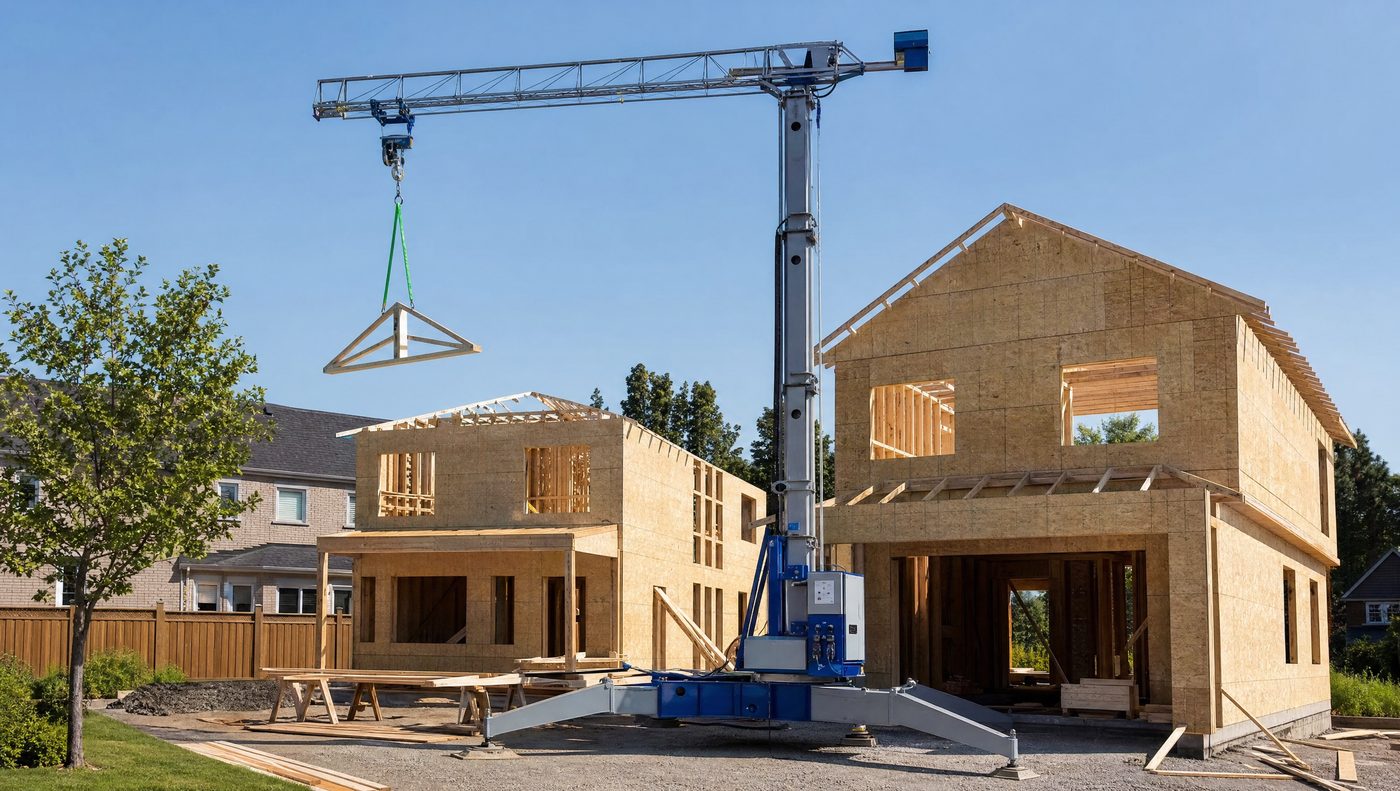
Lifting a roof truss above wood-framed houses under construction
Landmarks
Places and Landmarks in Tillsonburg
Tillsonburg's neighbourhoods were built in different decades, and each one presents a different starting picture for a lift. Hickory Hills is the first of the retirement subdivisions in the town, planned in the late 1980s with one-storey homes and its own residents association and community centre.
Brookside is one of the newer areas off Quarterline Road near the Tillsonburg Soccer Park, with larger single-family homes. Rolling Meadows is in the north end of town with convenient access to Highway 19 and features larger homes on sizeable lot frontages.
Westmount was originally part of the former Township of Dereham and has a large park and homes on very large lots dating back to 1970. Broadway Acres is a neighbourhood immediately adjacent to Broadway with homes built as far back as the 1960s.
Landmarks help describe where a site sits. Lake Lisgar is a small lake in the centre of town, Tillsonburg District Memorial Hospital is in the downtown area on Rolph Street, and the Rotary Club Clock Tower was built in the downtown in 1994.
The Tillsonburg Soccer Park opened in 2000 and has a land area of 14 acres, and Annandale House was designated a Canadian National Historic Site in 1997. Lot size, street layout and nearby open space all shape how a machine can be positioned, so a site description should name the street and the nearest landmark.
- Hickory Hills: one-storey homes planned in the late 1980s.
- Brookside: newer area off Quarterline Road near the Tillsonburg Soccer Park.
- Rolling Meadows: north end of town with access to Highway 19.
- Westmount: large lots and a large park, with homes dating back to 1970.
The local ground ·
Local Rules in Tillsonburg
The main local rule reference for Tillsonburg is its Zoning By-Law, which is reviewed on the County of Oxford website. Zoning governs how land can be used and what can be built on it, so it is the first place to read when a lift is tied to new construction, an addition or a placed structure on a lot.
Tillsonburg is located in Oxford County, Ontario, about 50 kilometres southeast of London on Highway 3, and the original settlement was located on the Big Otter Creek. In general, a lift that puts a machine on a public road, a boulevard or a sidewalk can involve the road authority, and a lift on private land depends on the lot's own limits.
Whether any approval is needed for a specific setup is a question for the municipality, and it is better asked before a date is booked than after. Overhead lines, buried lines and nearby buildings also set practical limits that no by-law replaces.
A by-law reference answers what is allowed on a lot, while a site plan answers where the machine will actually stand. Settling both before the lift is booked matters, because a change after the machine arrives can mean a second mobilization and a schedule that slips.
Tillsonburg ranges from 1960s streets in Broadway Acres to newer areas off Quarterline Road. Oxford County owns the drinking water distribution system and the Town operates it, so buried lines, hydrants and seasonal ground conditions are part of describing any lift site.
- For your lift Street layout and one-storey rooflines are part of describing a lift site in this area.
- For your lift The nearest landmark and street help describe a lift site in this newer area.
- For your lift Lot frontage is one of the things that shapes where a machine can be positioned.
- For your lift Lot size and nearby open space are part of the setup picture for a lift here.
- For your lift Older streets make an access check from the road to the setup position worthwhile.
- Tillsonburg's drinking water distribution system is owned by Oxford County and operated by the Town.For your lift Buried water lines sit under yards and streets where heavy machines may be set up.
- The Town advises contacting OntarioOneCall.ca before planting a tree, building a deck or a fence to get a free locate of underground lines and pipes.For your liftA locate of underground lines is a sensible step before heavy machine outriggers go down.
- For your lift Zoning is the reference for lifts tied to new construction on a lot.
Season and site
Season and Site Conditions in Tillsonburg
The Town conducts watermain and hydrant flushing on a regular basis throughout the year, typically in the spring and fall. In extremely cold temperatures, poorly insulated or shallow water services can freeze, and watermain breaks usually result from external corrosion of the pipe and typically occur in the winter season as the surrounding soil expands and contracts with extreme weather changes.
Residents are asked to keep fire hydrants clear of snow, brush, garbage and vehicles at all times so they can be accessed in an emergency, and the Town advises contacting OntarioOneCall.ca before planting a tree, building a deck or a fence to get a free locate of underground lines and pipes.
Those same conditions shape a lift. Frozen ground can feel firm yet crack or heave, and thawing ground can turn soft under outrigger pads. Wet weather can reduce the grip of a gravel base or a lawn. Snow can hide the edges of a pad area, a hydrant or a curb.
Ground bearing is assessed before a machine is set, and mats or cribbing are often used to spread the load. Wind also matters because a suspended load can swing, so lifts are paused when gusts make control difficult.
Planning the date with the season in mind can help avoid a second mobilization.
- Watermain and hydrant flushing typically happens in spring and fall.
- Shallow water services can freeze in extremely cold temperatures.
- Watermain breaks typically occur in winter as soil expands and contracts.
- Hydrants are to be kept clear of snow, brush, garbage and vehicles.
How a lift is planned
How the Work Is Planned
A well-planned lift starts with the load. Its weight, size and shape set how large a machine is needed, and the distance from the machine to the landing spot sets the reach. The next check is access: the path from the street to the setup position has to be wide, firm and clear of low wires and branches.
The setup position is then chosen so the boom can swing and the load can travel without passing over people or traffic. Ground under the outriggers is checked for soft spots, buried services and slopes. Lifting gear is matched to the load, and a spotter or signal person guides the operator when the landing spot is out of view.
On the day, the load is raised slowly, steadied and set down, and the machine is packed up once the placement is confirmed. Walking the site beforehand with the owner or the contractor in charge keeps each of those points from turning into a surprise on the day.
Confirm the load and landing spot
Weight, size and shape of the load and the exact place it has to land set the machine size and reach.
Check access from the street
The path to the setup position is checked for width, firm footing and low wires or branches.
Check the ground and overhead space
Soft spots, buried services, slopes and overhead lines are noted before the outriggers go down.
Set up, lift and confirm placement
The load is raised slowly with a spotter guiding the operator, set down, and the machine is packed up once placement is confirmed.
Describe your Tillsonburg site and the load, and plan the lift around the ground and the
season.
Share the load, the height and the site access, and we will come back with the crane that fits.