
HomeCrane rental
Crane Lift Planning in Burlington
Crane lifts in Burlington are planned around the load, the reach and the terrain at the address.
Request Your Ontario Crane Rental Quote
Add your site address, the load and the pick height so we can plan the right crane.
Rather talk it through? (226) 400-2111
In short
Crane lift planning in Burlington starts with the load, the lift radius and the ground at the address. Burlington's land area is made up of the Niagara Escarpment, Lake Ontario and the sloping plain between them, so setup spots, access routes and ground conditions can differ from one site to the next. Each lift is planned for its own address.
Crane lifts in Burlington are planned around the load, the reach and the ground at the address. Burlington's land area is made up of the Niagara Escarpment, Lake Ontario and the sloping plain between them, so setup spots and access routes can differ a lot from one site to the next. Each lift is planned for its own address.
- The problem we solve
- You need a lift planned so the crane can reach the site, stand on firm ground and set the load without delays.
- What we cover
- Crane lift planning for Burlington addresses, built around the load, the reach, the access route and the ground.
- Why local ground matters
- Burlington's land area is made up of the Niagara Escarpment, Lake Ontario and the sloping plain between them, so every lift needs its own plan for access and ground.
The local ground ·
Local rules in Burlington
Burlington's land area is made up of the Niagara Escarpment, Lake Ontario and the sloping plain between them. The local sections of the Niagara Escarpment are a UNESCO designated World Biosphere Reserve. The most northerly tracts of Carolinian forest thrive on the Escarpment that runs through western sections of the city.
These three geography facts describe the ground and the landscape a crane lift may have to work within. Steep, loose or wet ground needs more preparation than level, firm ground, because a crane must be levelled and its supports must sit on something that will not shift.
Mats or pads spread the weight of the supports over a wider area. A sloped lot may call for a different setup than a flat lot. Trees, buildings and overhead lines limit where a boom can swing, and a wooded site can narrow the route a crane takes to reach the setup spot.
When the access route is tight, a smaller crane or a different rigging approach can be the safer choice. Rules that apply to one address, such as road occupancy, park use or work near protected land, are confirmed for that address rather than assumed.
Burlington ranges from the Lake Ontario shore to the Niagara Escarpment, so access, ground bearing and overhead clearance are checked for each address.
- For your lift Crane setup and access on sloped or lakeside ground.
- For your lift Landscape context for lifts near the Escarpment.
- Burlington's monthly mean temperatures range from 22.5 °C in July to -4.4 °C in January.For your lift Seasonal ground conditions for crane setup.
- Burlington's average annual precipitation is 763 mm of rain and 99 cm of snow.For your lift Wet, snowy or frozen ground affecting access and stability.
- Spencer Smith Park on the Lake Ontario shore has a shoreline walking path, an observatory, a water jet play area and a restaurant.For your lift Waterfront sites with public use around the lift area.
- The Royal Botanical Gardens in Burlington is the largest botanical garden in Canada and a National Historic Site.For your liftA well-known Burlington site where careful lift planning matters.
- Millcroft is a community in Burlington with a park that has a splash pad.For your lift Community named for lift address planning, including pool and swim spa placements.
- Alton is a Burlington community that has a community centre hosting You(th) Belong programs.For your lift Community named for lift address planning.
How a lift is planned
How the work is planned
A crane lift is planned around the load, the reach and the site. The first job is to confirm what is being lifted, how much it weighs and where it needs to end up. Next the access route and the setup area are measured, because the crane has to arrive and stand level before anything leaves the ground.
With the weight, radius and height known, a crane is chosen that can carry the load at the farthest point of the lift, since capacity drops as the reach grows. Soft, sloped or frozen ground is prepared with mats or pads.
Last, the load is rigged to its lifting points, raised slowly and set in place. Different jobs change the details: a pool or swim spa needs rigging that protects the shell, a rooftop unit needs clearance over the roof edge and a steel beam needs a clear landing spot.
Everyone on site should know where to stand and which area is kept clear while the load is in the air. The plan is written for the address, not copied from another job.
Confirm the load and the landing spot
Establish what is being lifted, its weight and where it must be set down.
Measure access and setup area
Check the route in and the level space available for the crane's supports.
Match the crane to the radius
Choose equipment that can carry the weight at the farthest point of the lift.
Prepare the ground
Lay mats or pads where the ground is soft, sloped or frozen.
Rig and set the load
Attach the load to its lifting points, raise it slowly and place it.
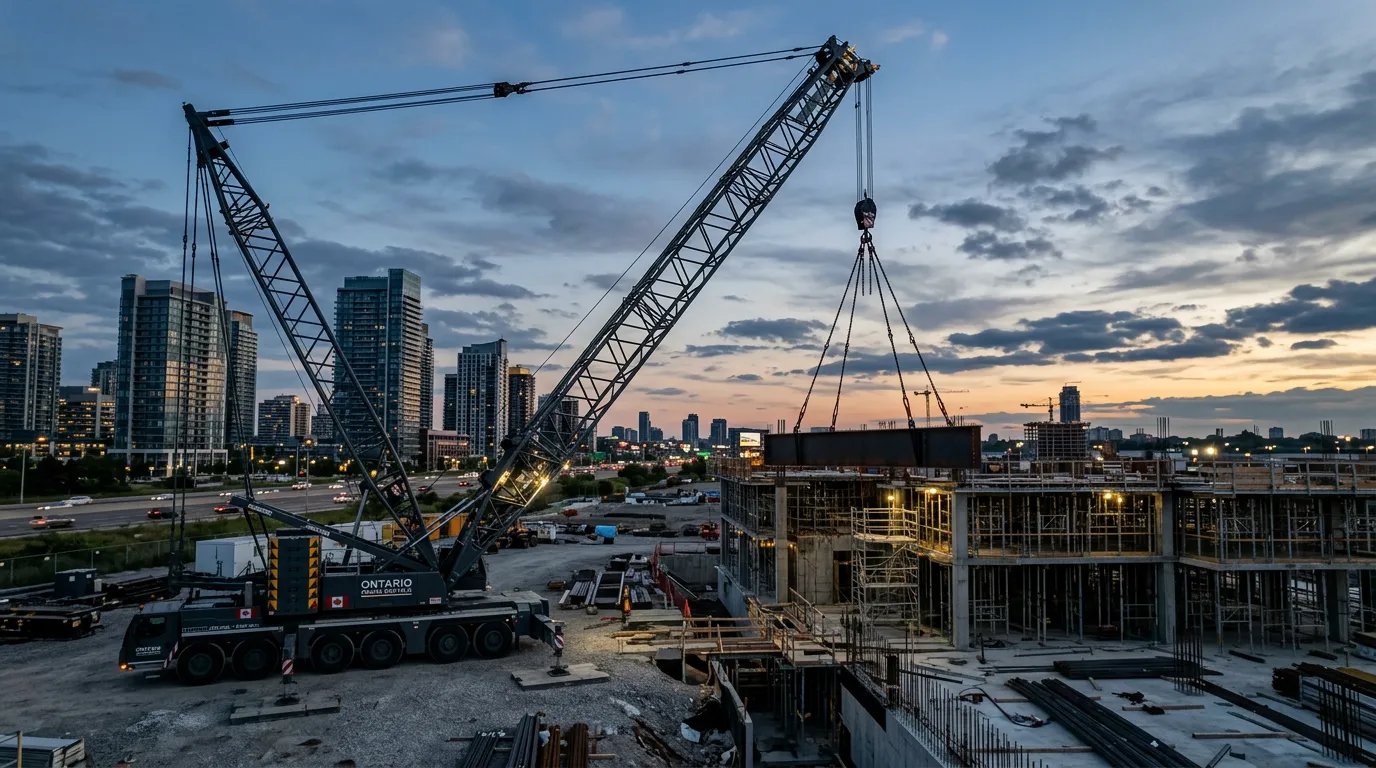
Share the load and the address so the lift can be planned for the site.
Share the load, the height and the site access, and we will come back with the crane that fits.